


ILENIA FICILI - Department of Engineering, University of Messina, Italy
MAURIZIO GIACOBBE - Department of Mathematics and Computer Sciences, Physical Sciences and Earth Sciences, University of Messina, Italy
GIUSEPPE TRICOMI - Department of Engineering, University of Messina, Italy
ANTONIO PULIAFITO - Department of Engineering, University of Messina, Italy
MAIN ARGUMENTS and KEY TOPICS
1) Core Architectures and Concepts
Cyber-Physical Systems (CPSs):
● Systems integrating physical environments (sensors/actuators) with cyber components (computation/networking).
● Computing Continuum: A seamless environment where tasks are executed across Cloud, Fog, and Edge devices to optimize performance.
● Systems of Systems: A methodology treating CPS as a complex integration of multiple independent systems that must be managed.
● IoT as Full-fledged Resources: Integration of Internet of Things devices as standard computing, storage, and networking assets.
2) Deployment and Operational Paradigms
●Deviceless Paradigm: Exploiting device resources on demand without static preparation or manual configuration.
● Virtualization and Composition: Abstracting sensors, boards, and edge devices to create a flexible infrastructure for services and applications.
● Edge-to-Cloud AI Integration: Deploying Artificial Intelligence models throughout the continuum to enable autonomous decision-making and data analytics at the source.
● Functional Pipelines: Executing application elements as dynamic sequences (pipelines) directly at the Edge.
3) Optimization and Management:
● Latency Minimization: Reducing delays by executing tasks near the physical elements (at the Edge).
● Bandwidth Consumption Optimization: Processing data locally to avoid unnecessary data transfer to the Cloud.
● Hierarchical Coordination: Edge: Local task execution.
● Fog Nodes: Local coordination and resource management.
● Cloud: Compute-intensive activities and overall system orchestration.
● Anomaly Anticipation: Using AI to predict issues and adjust to environmental changes instantly.
● Educational and Methodological Tools
● Heterogeneous and Green Infrastructures: Focus on diverse and sustainable technological setups for smart cities and industries.
● Hands-on Experiments: Practical application of theory through concrete examples.
Software Repository:
● Availability of ready-to-use modules, components, and applications for remote and continuous learning.

Andrea Pilzer: Solution Architect at NVIDIA leading the NVIDIA AI Technology Center in Italy where he focuses on supporting researchers on HPC clusters and NVIDIA technology. His main interests are in deep learning, video processing, VLMs and uncertainty estimation. He was postdoc at Aalto University working on uncertainty estimation for deep learning, worked at Huawei Ireland and got his Ph.D. in CS from University of Trento working with Nicu Sebe and Elisa Ricci.
Inference is at its inflection point, agentic AI is pushing inference compute demands beyond traditional limits.
For multimodal models, inference is even more demanding than for text only models (i.e. LLMs). In this tutorial we will leverage the NVIDIA Model-Optimizer library to apply simple and effective optimization techniques to boost your local model throughput. More in detail we will focus on quantization to reduce computational precision without significant accuracy loss, KV-cache compression to alleviate memory bandwidth bottlenecks, and speculative decoding to parallelize token generation and cut latency.
Authors:
• Francesco Guarnera, PhD – University of Catania, Italy
• Alessia Rondinella, PhD – University of Catania
of Rome, Italy
• Riccardo Raciti, PhD candidate – University of Catania, Italy
Magnetic Resonance Imaging (MRI) of the brain is a fundamental tool for the diagnosis,
monitoring, and treatment planning of neurological disorders such as multiple sclerosis and
neurodegenerative diseases.
At the same time, building reliable AI solutions on top of
brain MRI data remains challenging due to heterogeneous acquisition protocols, scanner
variability, limited dataset size, and the need for clinically meaningful and robust models .
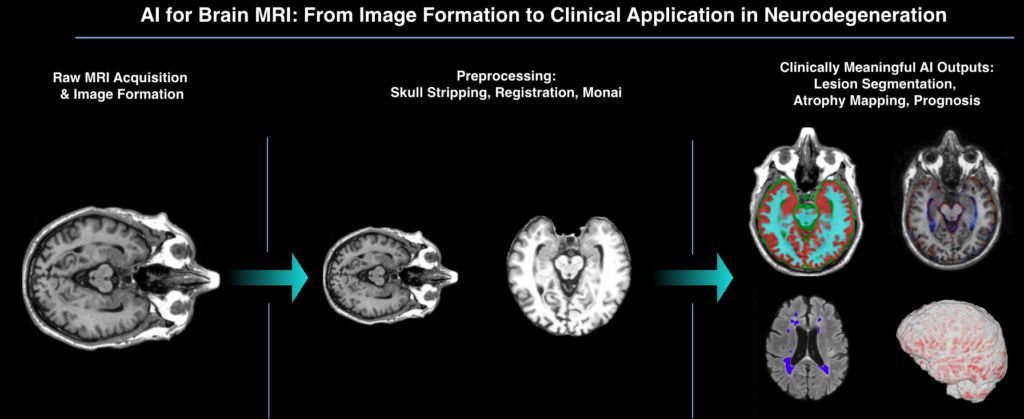
This tutorial provides an end-to-end view of AI pipelines for brain MRI, from the formation of
MR images and their standardization, to advanced deep learning methods for lesion
segmentation, brain atrophy mapping, and brain age estimation. Starting from basic notions
of MRI contrast, sequences, and artifacts, we discuss core preprocessing steps such as skull-
stripping, bias field correction, registration, intensity normalization, resampling, and
tissue/lesion labeling, showing how they impact downstream learning tasks.
We then focus on concrete tasks and publicly available datasets for multiple sclerosis and
neurodegeneration, with emphasis on recent resources for MS lesion segmentation and
multimodal MRI collections used for longitudinal analysis and brain age estimation. For each
task, we review state-of-the-art deep architectures, including attention-based 3D CNNs,
diffusion-based models, and U-Net variants for fast atrophy estimation, highlighting
strengths, limitations, and open problems.
The tutorial concludes with a hands-on session where participants will interact with brain MRI
data, run typical preprocessing pipelines, and experiment with ready-to-use deep learning
models for lesion segmentation and brain structure change estimation.
The target audience includes researchers and practitioners in computer vision, AI, and signal
processing who wish to enter or strengthen their activity in medical imaging, with a particular
focus on brain MRI and clinically oriented tasks aligned with AVSS topics on medical imaging
for safety, monitoring, and healthcare.
Pamela Zontone and Lucio Marcenaro, University of Genoa, Italy
Overview:
This tutorial explores Cognitive Dynamic Systems (CDSs) and the concept of self-awareness, an emergent property of autonomous systems and intelligent agents. Cognitive approaches suggest that agents, like humans, should continuously learn from experience, progressively improving their ability to handle uncertain, dynamic, and unexpected environments.
Participants will gain an understanding of how Dynamic Bayesian Networks (DBNs) contribute to the development of essential capabilities in autonomous systems, including Bayesian reasoning, hierarchical modeling, multi-sensor integration, data-driven learning, and explainability.
Topics/Subtopics:
This tutorial introduces CDSs and their role in fostering self-awareness in autonomous systems. It begins with an overview of the foundations of probability theory, including probability distributions, conditional probability, and Bayes’ rule, establishing the theoretical basis for probabilistic reasoning in dynamic environments.
The session then explores automated driving as a motivating application domain, reviewing the state of the art in Automated Driving Systems (ADSs), the SAE levels of automation, and key challenges. Building on this, the concept of cognitive dynamic systems is introduced, highlighting the transition from traditional dynamic systems to architectures featuring awareness and self-awareness, capable of learning and adapting over time.
Participants will then explore Probabilistic Graphical Models (PGMs), including Dynamic Bayesian Networks (DBNs), and learn how the Markov condition and message-passing algorithms enable structured reasoning under uncertainty. The tutorial proceeds to cover Bayesian filtering techniques, such as the Kalman Filter (KF), Particle Filter (PF), and Markov Jump Particle Filter (MJPF).
Finally, examples of self-aware systems will be presented, focusing on applications in anomaly detection, incremental learning, and recent research case studies.
Rationale for the tutorial:
Autonomous systems and intelligent agents are increasingly prevalent in modern technology. Central to their effective deployment is the concept of self-awareness, which enables systems to monitor, reason about, and adapt their behavior in dynamic and uncertain environments. Despite its critical importance, self-awareness in autonomous systems remains an emerging topic in the signal processing community, particularly regarding its integration with probabilistic modeling, sensor fusion, and real-time learning.
This tutorial addresses this gap by introducing CDSs and DBNs as principled frameworks for modeling temporal dynamics and reasoning under uncertainty. By covering Bayesian filtering techniques (Kalman, Particle, and Markov Jump Particle Filters), hierarchical probabilistic modeling, and self-awareness mechanisms, participants gain exposure to novel concepts, tools, and methodologies that can be applied to signal processing problems such as anomaly detection, adaptive sensor fusion, and state estimation.
The timeliness of the tutorial is underscored by the rapid adoption of autonomous technologies and the growing need for explainable, adaptive, and resource-efficient signal processing solutions. Attendees will acquire practical insights and theoretical foundations that not only enrich current understanding but also inspire new research directions and applications, bridging cognitive systems and signal processing in innovative ways.



The MicrosoftCMTservice was used for managing the peer-reviewing process for this conference. This service was provided for free by Microsoft and they bore all expenses, including costs for Azure cloud services as well as for software development and support.